

The Daily Word
Hear the Daily Word on

Get the Daily Word in Your Inbox!
To Go or Not To Go
As we enter into the Season of Advent, we begin a new liturgical year and we give thanks to God for all the blessings He has bestowed on us this past year. As we look forward to this new year, we ask the Lord to give us a hopeful heart, a heart that waits in joyful expectation for the coming of the Lord. The Church gives to us these seasonal markers of the year to invite us to a deeper relationship with God, helping us focus our prayer and meditation on the mysteries of Jesus’ life. Advent marks the beginning of the liturgical year, the four week period that leads to Christmas, the birth of Our Lord and Savior.
As we enter into the Season of Advent, we begin a new liturgical year and we give thanks to God for all the blessings He has bestowed on us this past year. As we look forward to this new year, we ask the Lord to give us a hopeful heart, a heart that waits in joyful expectation for the coming of the Lord. The Church gives to us these seasonal markers of the year to invite us to a deeper relationship with God, helping us focus our prayer and meditation on the mysteries of Jesus’ life. Advent marks the beginning of the liturgical year, the four week period that leads to Christmas, the birth of Our Lord and Savior. In today’s commercialized world we often skip Advent and jump right to Christmas. We can see this in stores where Christmas trees and decorations are put up the day after Halloween! Even in our own homes and schools we have this undisciplined tendency to jump to Christmas, but we must not do the same in our hearts. There will be no Christmas without Advent so we must use this time given to us to truly prepare our hearts for Christmas, not for the dinners and presents, but for the coming of the Lord, the Word made flesh who comes to dwell among us.
Advent comes from the Latin word adventus meaning “coming” or “arrival.” So Advent is the period of preparation and expectation of the coming of the Prince of Peace. At the same time is it also a journey. We are invited to journey with Mary and Joseph to Bethlehem to wait in joyful anticipation of the birth of Jesus. We wait for the coming of Jesus. His first coming was of course more than 2000 years ago in Bethlehem. We also know that His second coming will be the day He comes to judge the living and the dead. But there is also a “third” coming of Christ, and this is the here and now, when the Lord comes to meet us in the silence of our hearts, in Scripture, in the sacraments, and in our encounter with one another.
So, today, we stand in the present moment, the first Sunday of Advent in the year 2025, and we recall and remember the first coming of our Lord while anticipating His second coming with the sure knowledge and trust that He is with us here too in this very moment. Let us give thanks for the moment in time when the Word was made flesh for our sake so many centuries ago and let us prepare our hearts for the day, that as Scripture tells us we know neither the day nor the hour, He will come again in His glory to judge the living and the dead, separating the sheep from the goats, and gathering all of His Father’s children to Himself, so that where He is we all might be (cf. John 14:3).
As we begin this new liturgical year and this holy season of Advent, will we wait idly and passively or will we wait actively in joyful expectation, telling everyone about the Lord and His love and mercy, the Light for those who have been walking in the darkness and the Consolation for all those who have been silently crying out to the Lord in their grief, sorrow, doubt, and frustration? Mary and Joseph are all packed and ready to walk to Bethlehem, and they turn around, meeting your gaze, asks you, “Will you come with us?”

Are You Satisfied?
On Corpus Christi Sunday we are invited to contemplate the great gift of the Eucharist, the Body and Blood of Our Lord, and this year we hear the Lukan account of the multiplication of the loaves. After a day of teaching, the Apostles asks Jesus to dismiss the crowd so they can go find food and lodging. But, Jesus replies with something that might sound shocking — “Give them some food yourselves.” Five loaves and two fish were all they had and this needed to feed 5000 men along with any women and children. So, Our Lord said the blessing over the loaves and fish, broke them, and gave them to the people and we are told “they all ate and were satisfied.” When the Lord broke the loaves, all were fed and were satisfied. When the bread is broken on the altar and we eat, are we satisfied?
“They all ate and were satisfied.”
Luke 9:17a
On Corpus Christi Sunday we are invited to contemplate the great gift of the Eucharist, the Body and Blood of Our Lord, and this year we hear the Lukan account of the multiplication of the loaves. After a day of teaching, the Apostles asks Jesus to dismiss the crowd so they can go find food and lodging. But, Jesus replies with something that might sound shocking — “Give them some food yourselves.” Five loaves and two fish were all they had and this needed to feed 5000 men along with any women and children. So, Our Lord said the blessing over the loaves and fish, broke them, and gave them to the people and we are told “they all ate and were satisfied.” When the Lord broke the loaves, all were fed and were satisfied. When the bread is broken on the altar and we eat, are we satisfied?
When my students casually say “I’m hungry,” I would sometimes half-jokingly ask, “Did you go to Mass? If so, you shouldn’t be hungry. You’ve eaten of the Bread of Life!” Of course we will still be physically hungry after receiving Communion, but we ought be spiritually full, for the Eucharist is the “source and summit of the Christian life,” and is the sustenance that feeds our souls. But how often do we seek other ways to satiate ourselves? Sometimes we try satisfy our needs and wants in ways that may even be inordinate and sinful, but why? Is the Lord not enough for us? What is it that we desire in life? Is it the Lord? Is it Communion with Him? Do our actions and way of living show this?
Today on this Corpus Christi Sunday let us contemplate on the gift of the Eucharist and how we approach this most awesome sacrament. When the Lord comes to meet us at the altar and blesses the gifts and the Holy Spirit turns the bread and wine into the Body and Blood of our Lord, and we go to meet Him and receive Him, will we be satisfied? Let’s not forget, after being fed and satisfied, we are told there were 12 wicker baskets filled with leftovers. Likewise, after receiving the Lord Himself, the graces do not end there. There are 12 wicker baskets overflowing with graces that the Lord wishes to give to us. We need only go to Him, and we will eat and truly be satisfied indeed.
That From Which We Come
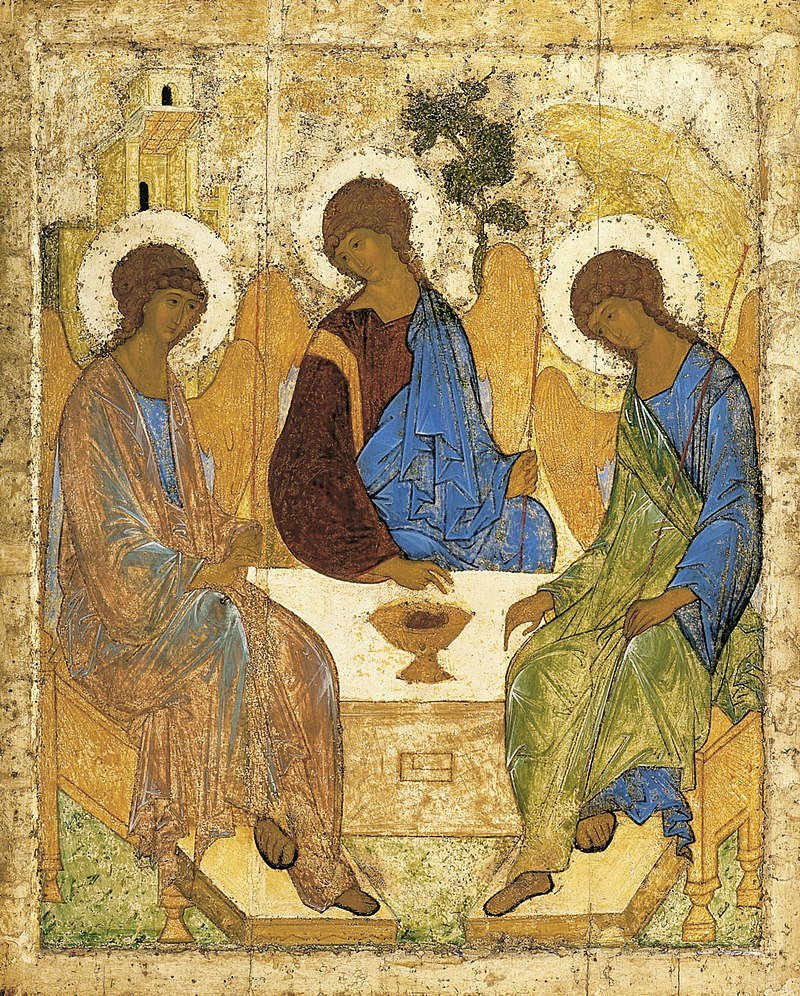
As Christians we believe in a Trinitarian God, that is One God, Three Divine Persons — Father, Son, and Holy Spirit. We have come to know that God is a Trinity through divine revelation — Scripture and Tradition. It is not something that we can test or prove, but rather a mystery that invites us to wonder.
“The love of God has been poured out into our hearts
through the Holy Spirit that has been given to us.”
Romans 5:5b
As Christians we believe in a Trinitarian God, that is One God, Three Divine Persons — Father, Son, and Holy Spirit. We have come to know that God is a Trinity through divine revelation — Scripture and Tradition. It is not something that we can test or prove, but rather a mystery that invites us to wonder.
When we ponder the mystery of the Trinity we are really pondering the nature of God. The Trinity exists as a community, a community of Persons. St. Augustine taught that the Father is the Lover, the Son is the Beloved, and the Holy Spirit is the Love that exists within that relationship. Love is only possible within a relationship and a relationship exists only between persons. So, God is a community of Persons who are in relationship with One Another, and this relationship is love. But, this Community of Love is not closed off, but rather God sent His Son into this world so that we too might become partakers in this special relationship.
By virtue of our baptism, we have been made children of God. We have become “heirs and coheirs with Christ,” meaning that whatever the Father gives to the Son, He also gives to us. We have been invited to partake in the very life of God. As such, we have been asked to partake in this life, living out this love in our lives in this world. It is not always easy. It is a choice that we must make every day — to choose love and to choose to see how God sees things, situations, and people, even those whom we do not like, every day. But we know God will give us the grace that we need to do so. That’s part of the mystery of God’s love, too. That He thinks so highly of us that He would call us His children and to love us unconditionally and to sustain us in all that we do and to forgive us and bear with us even when we do the most egregious of things.
May we never forget the great Love that God is and the love with and for which He has created us, and allow that to encourage us to live out our lives, choosing every day to love.
For another Trinity Sunday reflection, click here.