

The Daily Word
Hear the Daily Word on

Get the Daily Word in Your Inbox!
Being Lifted Up
“Just as Moses lifted up the serpent in the desert,
so must the Son of Man be lifted up,
so that everyone who believes in him may have eternal life.”John 3:14-15
What comes to mind when you hear the phrase “being lifted up?” Perhaps “praise” or “accolades” or being spoken well of. Maybe even the phrase “being put on a pedestal” or being shown off and made a spectacle of. In today’s Gospel we hear Jesus telling Nicodemus that just as Moses lifted up the serpent in the desert so too will He be lifted up. The background to this is when the Israelites were being bitten by snakes in the desert, God told Moses to mount a serpent onto a pole and whoever looked at it will be saved. In the same way, Jesus is saying that He will also be lifted up and all those who would come to look at Him will also be saved.
Isn’t it ironic that the symbol of a criminal’s death - the most gruesome death, the crucifixion has become that by which we have eternal life? In the desert it was a mounted snake that healed the people, but outside Jerusalem it was God’s only begotten Son who not only healed the people but who also saved the world and gave eternal life. Because the Light came into the world, we no longer need to walk in the darkness. Because the Son of God took on the burden of our sins, we can stand up and run as free men and women. Because the Son of Man was lifted up, we can dare call God Our Father and we His beloved children. This “being lifted up” was no act of showy pride, but rather the greatest expression of humble love. God became man so that He can suffer and be nailed to a cross and lifted up high so that all - even and especially the lowliest and most vulnerable of all may dare look up and be saved.
May we today look up at the Cross, and give thanks for having been so loved.

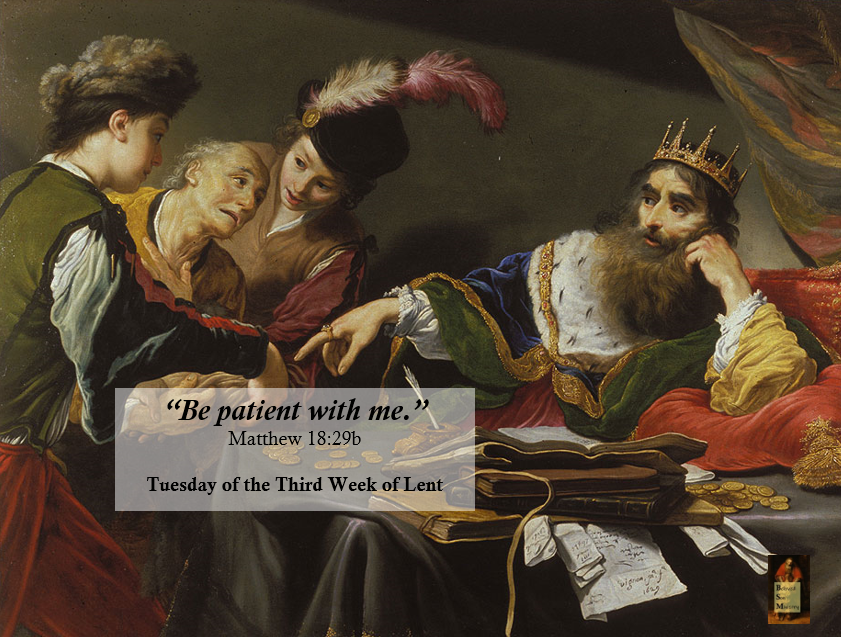
Be Patient with Me
“Be patient with me.”
Mt. 18:29b
"Be patient with me." Those were the words the servant used to plead with his king when he was about to be sold along with his family and possessions in the Gospel (Mt. 18:21-35). We are told that "moved with compassion the master of that servant let him go and forgave him." Compassion. Patience. Forgiveness. When the servant asked for patience, he received forgiveness.
Both the words compassion and patience find their roots in Latin meaning to "suffer." To be compassionate is to "suffer with" and to be patient is to "suffer" in some way in our own person. Someone who is compassionate is able to empathize and sympathize with others, and someone who is patient is able to recognize the shortcomings of one's self and of others and so act and make decisions with that knowledge. Forgiveness occurs when that recognition and realization propels us to reflect on how we have been shown compassion and the times when we have been treated with patience. With compassion, patience, and forgiveness the human heart is touched and obstacles removed.
The king saw how earnestly his servant begged him and perhaps felt the pain and the suffering and even the frustration and shame he must have been experiencing. Seeing that this man was sorry and wanted to do better not just for himself but for his family, the king showed mercy, was moved with compassion and bore patiently with him and forgave him of his debts. In his ignorance, the servant asked for more time so that he can repay the debt, but this debt was larger than any among he could ever earn in his lifetime. What the king gave to the servant was not patience, but forgiveness. However, when it was time for him to do the same, the forgiven servant failed to act with compassion and patience.
After being forgiven the servant himself saw someone on then streets that owed him something. But when that person pleaded with him saying, "please be patient with me," the forgiven servant ignored him and threw him in prison instead. The king found out about this and "handed him over to the torturers."
We are told that we ought to forgive others because God forgives us. Forgiveness is not just something that is received. It must be given too. When we reflect on our own lives, how often have we asked for forgiveness and it was granted to us? And, how often have others begged us for forgiveness and we have denied it? Our God and Father is the model of how we ought to forgive. When we think about all of the sins and wrongs we have committed, big or small, and reflect upon how when we sought God's forgiveness it was given to us without any conditions (other than to be sorry), shouldn't that move us to forgive others? To us it seems like sometimes certain people do not deserve our forgiveness, but forgiveness isn't given because someone deserves it. If we only gave things to people because they deserved it, where is the compassion and patience in that? We give because we do not need to. We give because our hearts move us to do so.
In the same way there is nothing we can ever do to justly earn forgiveness from God or from others. God forgives out of love, and we ought to do the same. God does not withhold His mercy from us until we have repaid everything because if that's the case, we would never be forgiven. However, we are told in today's Gospel that if we do not forgive others just as the Father forgives us, neither will we be forgiven.
Let us bear patiently with one another, treat one another with compassion, and allow God to move our hearts and turn our hearts into hearts of love so that we can give to others the gift that He so generously gives to us: forgiveness. Let us to remember that God knows all that we need and all that our hearts desire. Oftentimes we may ask for one thing, but in turn God gives us something so much better, something that goes beyond our imagining. Today let us meditate and give thanks for the forgiveness we have received and ask the Lord for the grace to forgive others as well as ask the Lord for a open heart to receive all that He wishes to give to us, even those we dare not ask.

Perverting the Good
“‘Come, let us contrive a plot against Jeremiah. It will not mean the loss of instruction from the priests, nor of counsel from the wise, nor of messages from the prophets. And so, let us destroy him by his own tongue; let us carefully note his every word.’”
Jer. 18:18
When the Prophet Jeremiah preached repentance and invited the people to return to God, they disregarded him. In fact, they wanted to get rid of him, and to do so without getting their own hands dirty. Isn’t this what happened to Jesus? The Jews accused Jesus of blasphemy but asked the Romans to execute Him and schemed to have Jesus’ own friend and follower to hand Him over.
Jesus did not sugarcoat the conditions of discipleship. He told the people that it would not be easy and in fact they would even suffer and be hated for following Him. Yet they followed. Jesus also mentioned time and again of His own passion and death. Why would they still want to follow Him? Would we want to keep listening to and following someone who always talk about how much he will suffer? Talking about death and asking people to change their ways all the time. In today’s world, we might be accused of being all doom and gloom and not living life and telling us that no one would want to be around us. What is good and true, the world has perverted. Jeremiah only wanted the people to know the truth and for them to be with God, yet their pride closed their hearts from the saving message. Jesus wanted to lead the people to His Father and give them the gift of salvation, yet they seemed self-sufficient in their self-righteousness. What are some ways we have perverted a good, taking something good and twisting its goodness? Are our hearts closed? Am I blinded by my pride and the lie of my self-sufficiency? May we today ask the Lord for the grace to look within our hearts and to invite Him inside.
